
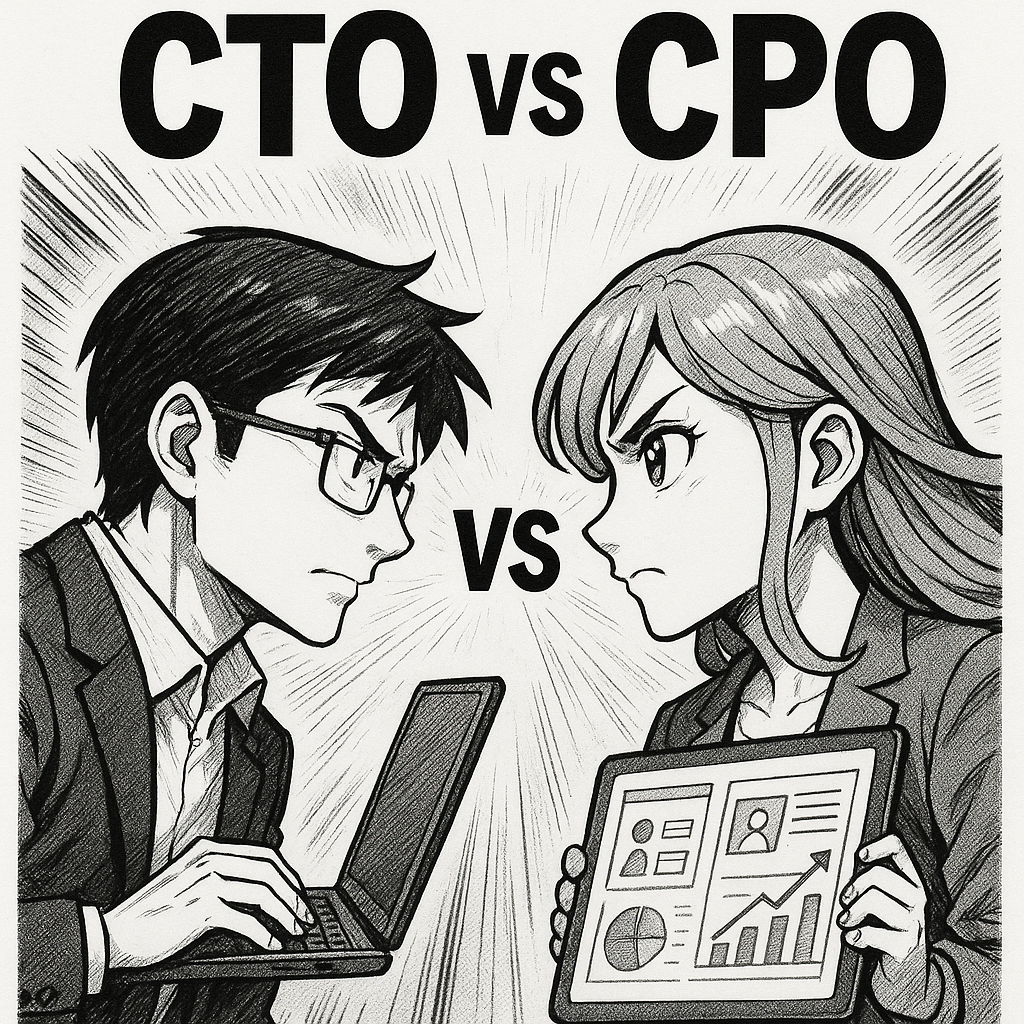
In a lot of startups, especially when resources are tight, concentrating talent in a few key roles is essential to get the most impact. In those situations, it's critical to keep the technical vision and the product strategy truly aligned. But as product and engineering teams grow and complexity piles up, you need someone who can span both worlds.
That's where the CPTO (Chief Product & Technology Officer) comes in as a strategic answer. By combining the responsibilities of the CTO and the CPO, a CPTO lets a startup cover everything a tech product needs, with execution that's fast, coherent and in line with the company's overall vision.
An emerging role at the heart of startups
A CPTO isn't simply a CTO plus a CPO. It's a profile that grows out of the need to align product, technology and business around a single vision. That's especially true in tech startups, where the product is the technology, and where every technical decision directly affects the user experience, profitability and the scalability of the business.
But for all its appeal, not every team is ready for a CPTO, or even needs one. And not every CTO is cut out to grow into that hybrid role.
Not every CTO should (or wants to) become a CPTO
There's a fairly common assumption that a good CTO can eventually take on the product side too. That it's just a matter of maturity. But that overlooks something fundamental:
Product leadership isn't just about technical knowledge. It's about empathy for the user, business sense and strategic vision.
Just as we don't expect every engineer to be a good people manager, we shouldn't expect every CTO to turn into a hybrid. Not everyone has that skill, or wants to develop it.
And that's fine. In fact, forcing that evolution can lead to frustration, bad decisions and a loss of focus.
CTO skills in a tech startup
- Solid experience in software architecture and technical decision-making.
- Ability to build and lead engineering teams.
- A sense for scalability, security and code quality.
- DevOps culture, automation, continuous integration.
- Ability to manage technical debt under business pressure.
CPO skills in a tech startup
- Deep knowledge of the user and the market.
- Command of the product lifecycle: discovery, delivery, feedback.
- Skills in prioritization, roadmapping and stakeholder management.
- A focus on value, impact, growth and metrics.
- Ability to turn business vision into concrete features.
CPTO skills: the strategic bridge
- Ability to connect technical feasibility with business viability.
- A holistic view: product, business, technology and team.
- Previous experience leading both product and engineering.
- Exceptional communication skills: translating technical complexity into business language and back.
- Product mindset plus architectural thinking.
- Ability to make hard calls with trade-offs between speed, value and scalability.
It's someone who thinks about the why before the how. Who knows when to say “no” to a feature and when to invest in a refactor that's invisible but crucial. And who, above all, understands that building a great product isn't just about writing good code.
Separate the roles or combine them?
There's no single right answer. At some stages, splitting CTO and CPO gives you focus and specialization. At others, having one person who brings both perspectives together gives you speed and coherence.
The key is to understand where the company is, what it really needs and who is on the team.
Just as we don't expect every engineer to be a good people manager, we shouldn't expect every CTO to turn into a hybrid. Not everyone has that skill, or wants to develop it.
What is clear is that the CPTO is an emerging role startups should have on their radar, especially if they want to scale without losing the link between what they build and the value they deliver.
What if the CPO had an AI that handled all the technical work?
Now that artificial intelligence is starting to automate part of software development, some people are asking:
What if the CPO had an AI that could execute their entire vision? Would we still need a CTO?
It's dangerous to think of technology as something that can be reduced to an order-taker. Because technical decision-making isn't just about writing code.
It's about assessing risk, scaling systems, ensuring quality, anticipating bottlenecks, defining sustainable architectures, protecting the security and integrity of the business…
And also knowing when not to build anything at all.
An AI can assist, speed things up, or even carry out technical tasks. But it can't yet, and shouldn't, make the decisions that sustain a product's technological evolution over the long term.
Thinking a CPO with a good AI can replace a CTO is like believing a strategist with an army of robots can win every war without a technical general who understands the terrain.
Ultimately, titles aside, what matters is having leaders who connect vision, execution and purpose.
The CPTO can be a great role if you find the right person. But not every technical path leads there. And that's okay.
Who really leads product at your startup? Have you considered this hybrid role?